The Person Who Sees the Problem May Not Be the Person Who Can Change It
Better measurement can make a problem visible without changing who has the authority to act on it. When evidence and decision rights sit in different parts of an organization, insight has to travel before it can become action
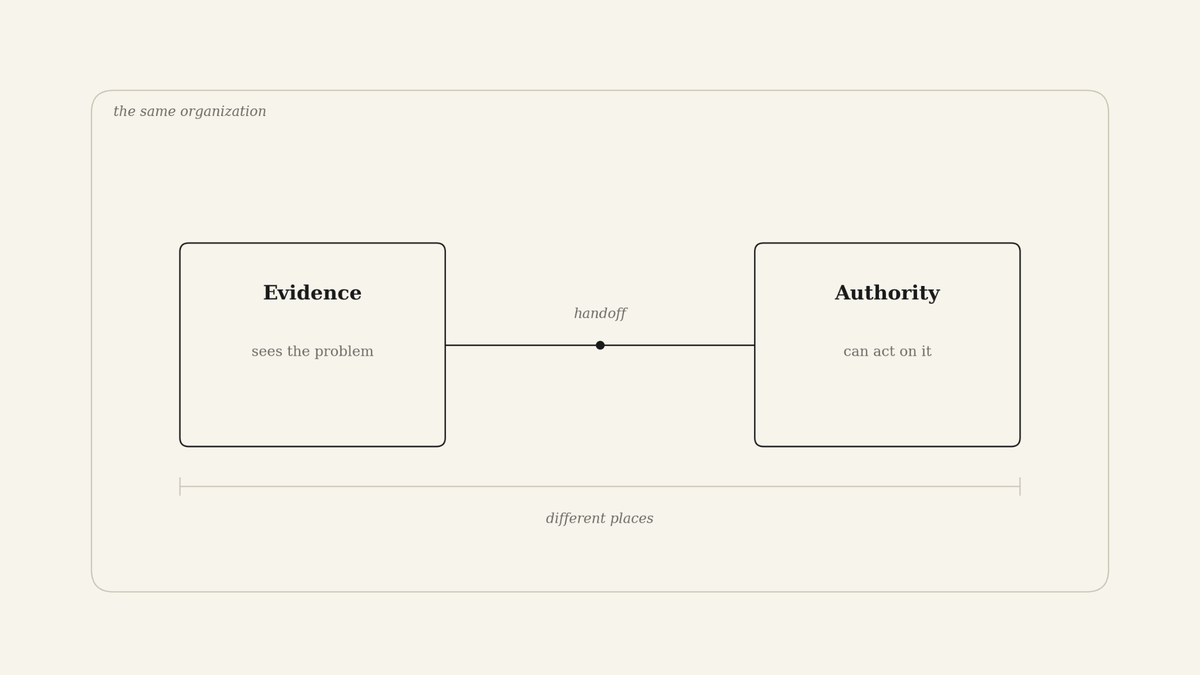
Seeing a problem is not the same as being able to fix it. Those can live in different parts of the same organization, at the same time, with nothing broken.
Working proposition
Improving what an organization can know does not automatically change who is able to act on it.
A measurement team detects that a promotion is destroying margin in a subset of stores and dayparts. The evidence is timely and credible. The team can see the problem, but it doesn't control the promotion's terms, the supplier agreement, or the commercial calendar. Trade Marketing does. Nothing prevents Trade Marketing from acting on this, in principle — the evidence just doesn't arrive there automatically because it exists.
This isn't the same failure as a decision that closes before the evidence arrives. The evidence here is on time. Nothing about the calendar is working against it. What's missing is a different kind of proximity — not evidence reaching a decision in time, but evidence reaching the authority that could use it. Two different nodes in the same organization, and better measurement, on its own, does nothing to move them closer.
The knowledge a measurement team has is specific — this promotion, these stores, this week. The authority to act on it often sits somewhere else, structured around a broader set of decisions than the evidence itself. Neither placement is wrong on its own — specific knowledge sits close to what's happening because that's where it's generated, and authority sits broader because that's what makes it usable across many decisions at once. They are not necessarily built to be in the same place, and improving one does not automatically move it toward the other.
This isn't a question of who should decide — that's a governance question, and organizations already have frameworks for answering it. The question underneath it is narrower: what happens when an organization's ability to know changes faster than its authority structure does? Measurement gets better every year. The structure that decides who acts on what doesn't update itself at the same pace, or for the same reasons.
The obvious fix is to send the finding to whoever can act on it. Sometimes that works. But a handoff is work — someone has to notice the mismatch, package the finding, route it, and wait. An organization where evidence and authority already meet doesn't need any of that. Where they don't meet, the organization has to do extra work just to make the evidence actionable.
None of this requires anything to go wrong. By the time a finding like this reaches the person who can act on it — filtered through a monthly review, summarized by someone else — the options still open to them may be narrower than when the finding was fresh. That's a different essay's problem. This one is about why the finding had to travel in the first place.
The question worth asking isn't who should be allowed to decide. It's simpler, and harder to fix: does the place where a problem becomes visible have a reliable path to the place where someone has the authority to change it? In a lot of organizations, measurement got better long before anyone answered that.
This essay is part of the In-Store Retail Media Framework under Decision Intelligence. New readers can begin with Start Here or explore the Principles that guide the Journal.