Attributed Sales: Closer, But Still Not the Answer
Attributed Sales connects exposure with purchase, but connection is not the same as causality. It gets us closer to impact without proving incrementality.
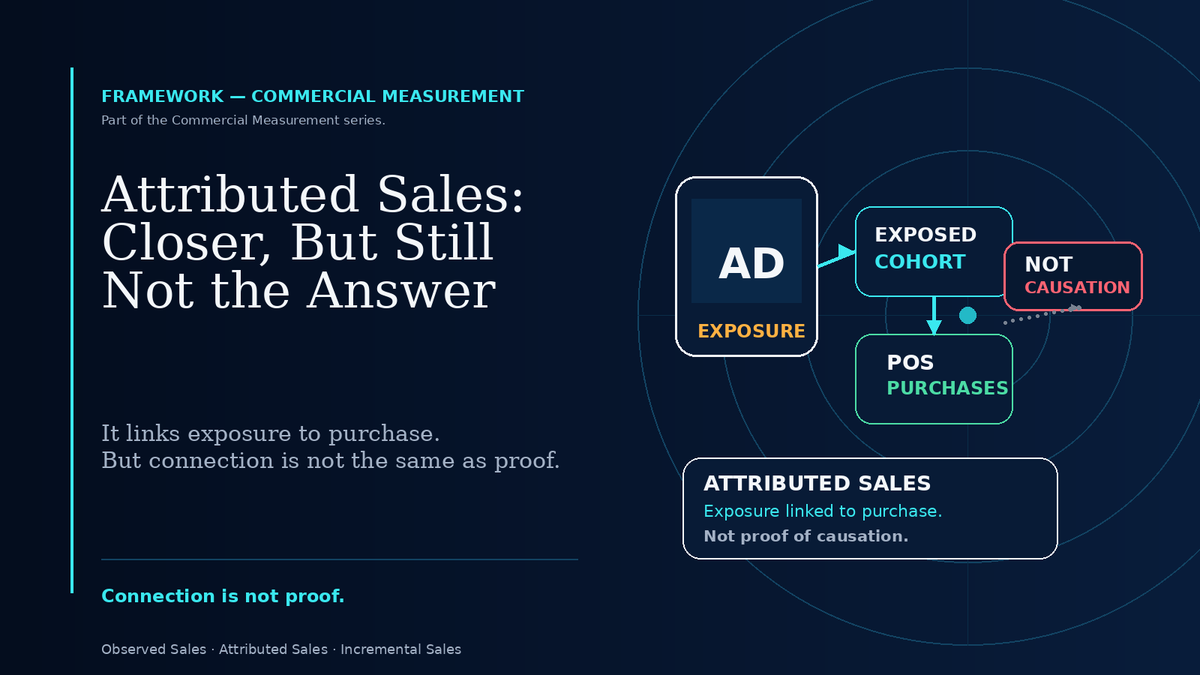
It connects exposure to sales. But connection is not the same as proof.
FRAMEWORK — COMMERCIAL MEASUREMENT
Part of the Commercial Measurement series.
Observed sales tell you what sold.
Attributed sales tell you what sold after exposure.
Neither tells you what the campaign actually caused.
In the previous essay, we established that observed sales describe what happened.
They don't explain why it happened.
Attributed sales try to answer that question.
That's progress.
But it's not the whole story.
Attribution is the process of linking media exposure to a purchase.
Someone walked past a screen displaying a campaign for a product.
That same person, later in the same shopping trip, bought that product.
Attribution connects exposure to purchase.
It does not prove that one caused the other.
In digital media, this logic is well understood.
A cookie or device ID links the ad impression to the conversion.
The methodology is imperfect—last-click attribution has been debated for decades—but the underlying connection is direct: the same user, in the same session, across a trackable journey.
In physical retail, the connection works differently.
There is no cookie.
There is no device ID.
Instead, what exists is a cohort—a group of shoppers detected in front of a screen, at a given time, in a given store, in a given aisle.
That cohort is then matched against POS data:
Did sales of the advertised product increase among shoppers who were present during the exposure window, compared to those who weren't?
This is cohort-based attribution.
Different mechanism. Same objective.
When it works well—when the sensor data is clean, the POS data is granular, and the match rate is high—attributed sales give you something genuinely useful.
Not just what sold.
But what sold after exposure.
That's a meaningful step forward.
But attributed sales still carry an assumption that needs to be named.
Attributed sales answer a stronger question than observed sales.
But they still don't answer the strongest one.
They tell you that sales were higher among exposed shoppers.
They don't tell you whether those sales happened because of the exposure—or whether those shoppers would have bought the product anyway.
A shopper who was already planning to buy a product will walk past the screen, be counted as exposed, and then buy the product.
Attribution will record that as a success.
But the campaign didn't cause that purchase.
The purchase would have happened anyway.
This is not a flaw in the methodology.
It's a limit that every attribution system shares—digital or physical.
Attribution identifies correlation.
It does not prove causation.
That distinction matters enormously when a CFO asks a simple question:
Did the campaign create new demand...
...or simply measure demand that already existed?
Attributed sales can't fully answer that question.
They can tell you the campaign reached people who bought.
They can't tell you the campaign made people buy who otherwise wouldn't have.
For that, you need a third number.
One that compares what happened in exposed contexts against what happened in contexts that were identical in every way—except for the campaign.
That number is incremental sales.
And it's where attribution ends...
...and true measurement begins.
Commercial Measurement Series
✓ Observed Sales: The Easy Number That Means Almost Nothing
✓ Attributed Sales: Closer, But Still Not the Answer
→ Incremental Sales: The Only Number That Should Matter to a CFO (Coming next)
This essay is part of the Commercial Measurement series within the In-Store Retail Media Framework.
Next in the series
Incremental Sales: The Only Number That Should Matter to a CFO
Or start with Start Here to explore the framework, or browse the Principles that guide every essay in this Journal.