Observed Sales: The Easy Number That Means Almost Nothing
Observed sales tell you what sold. They don't tell you why. And that difference is everything
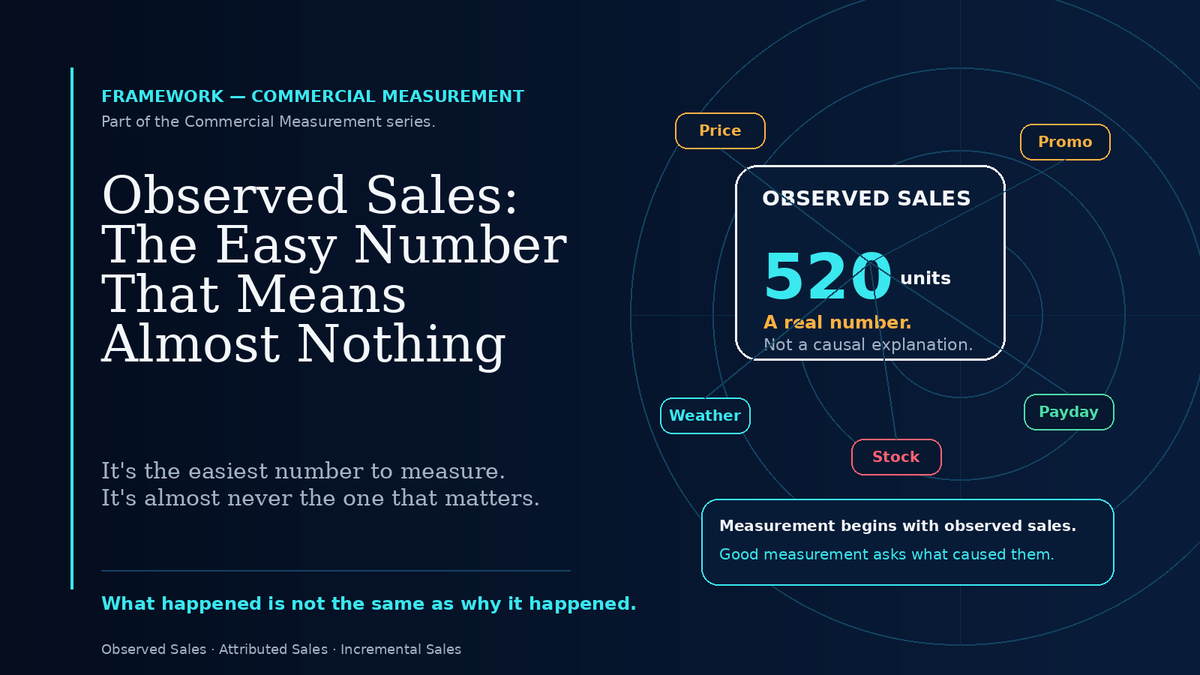
It's the easiest number to measure. It's almost never the one that matters.
FRAMEWORK — COMMERCIAL MEASUREMENT
Part of the Commercial Measurement series.
Every retail media campaign ends with the same question.
How much did we sell?
The answer is usually observed sales.
And that's where the problem begins.
Observed sales are simply what sold, in a store, during a campaign period. Total units. Total revenue. A real number, pulled from a real system.
But a real number isn't the same as a meaningful one.
Observed sales describe what happened. They don't explain why it happened.
If a product sold 500 units last week and 520 this week, while a campaign was running, the easy story is: the campaign worked. Twenty extra units. Proof of impact.
Except that story skips almost everything that actually happened.
Maybe the product was on promotion. Maybe a competitor was out of stock. Maybe the weather changed shopping patterns for the entire category. Maybe it's simply the week after payday, and the whole store sold more of everything.
Observed sales don't distinguish between any of these causes. They just report the total.
The number is real. The explanation is usually an assumption.
This matters more in physical retail than almost anywhere else.
Online, a click can be traced to an ad, a session, a user. In a store, dozens of variables move at once: footfall, weather, payday cycles, local events, stock availability, price changes, a competitor's own promotion two aisles over. Observed sales absorb all of it into a single figure, with no way to separate the campaign's contribution from the noise around it.
Observed sales are essential. Every measurement model starts there. No serious measurement model ends there.
A CFO evaluating a retail media budget doesn't want to know what sold. They want to know what sold because of the campaign — and what would have sold anyway.
That's a different question entirely. It's the one attributed sales starts to answer, and the one incremental sales is built to settle.
Observed sales are where measurement begins.
They're not where it should end.
Because commercial decisions are never made on what happened.
They're made on why it happened.
This essay is part of the In-Store Retail Media Framework, under Commercial Measurement. Start with the Start Here overview, or browse the Principles.