Not All Sales Results Make the Same Claim
Observed, attributed and incremental sales may all appear as “results,” but they make fundamentally different claims about Commercial Reality. The number alone does not tell you what you are entitled to conclude.
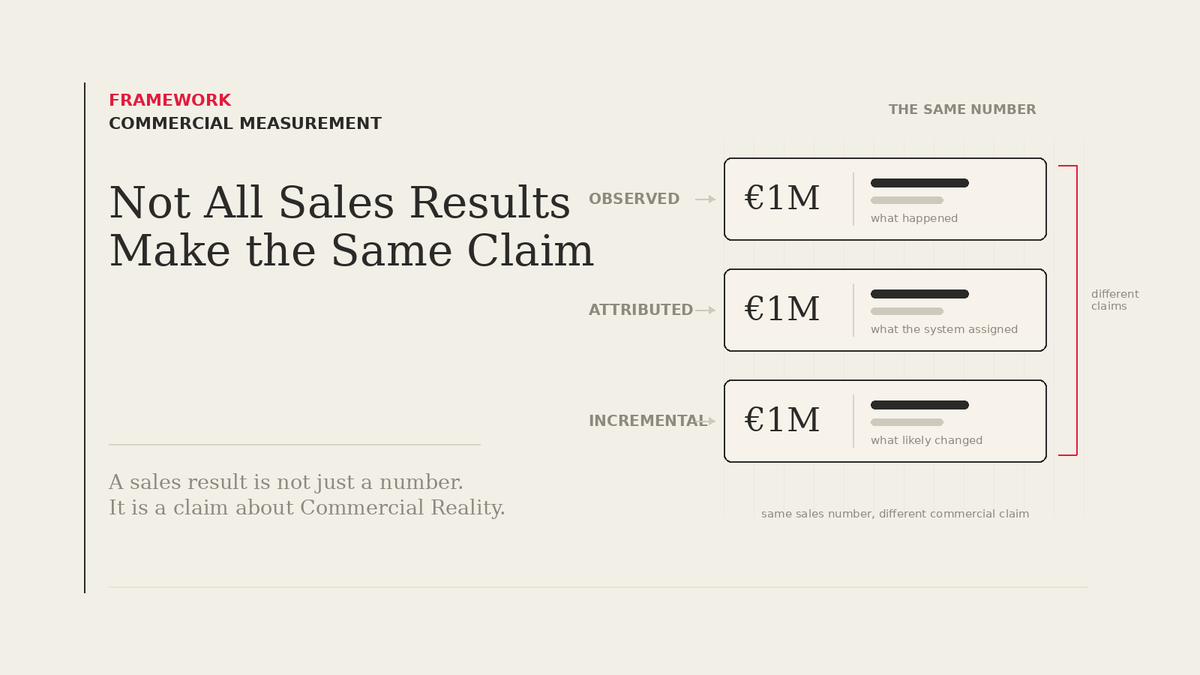
A sales result is not just a number. It is a claim about Commercial Reality.
Working proposition
The same sales number can support fundamentally different claims about commercial impact.
Imagine three dashboards.
Each shows the same number:
€1 million in sales.
The first says those sales were observed during the campaign period.
The second says those sales were attributed to shoppers exposed to the campaign.
The third says those sales were incremental.
The number is identical.
The claim is not.
In practice, these numbers rarely match exactly. But even when they do, the claims they support do not become interchangeable.
That distinction matters because organizations often compress all three into the same language:
results
sales driven
campaign sales
ROAS
Once that happens, the number can begin to carry more meaning than the measurement actually supports.
The number is not the claim
A number tells us something.
But it does not tell us, by itself, what kind of relationship exists between the number and the commercial activity we are trying to understand.
€1 million can describe what happened.
It can describe what a measurement rule assigned to a campaign.
It can describe an estimate of what likely happened because of the campaign.
Those are different statements.
The difference does not sit inside the number.
It sits in the claim we are making about it.
That is not a question of how the number was measured. It is a question of what the number then entitles us to conclude.
This is where sales measurement becomes easy to misunderstand.
The output is numerical, so it feels objective.
But the commercial meaning of that output depends on what the measurement system is actually entitled to say.
Observed sales make a claim about occurrence
Observed sales answer the most basic question:
What happened in the population, place or period we are looking at?
If a retailer records €1 million in sales during a campaign, that is a real commercial event.
Those transactions occurred.
The observation may be highly useful.
A category manager might need to know whether product is moving today.
A store team may need to know whether a promotion is being executed properly.
A media team may want to understand how exposed stores or shoppers behaved during a period.
None of those questions necessarily requires a causal claim.
Observed sales are not weak because they do not establish causality.
They are evidence of occurrence.
The problem begins when occurrence is described as impact.
€1 million happened.
That alone does not tell us why.
Attributed sales make a claim about assignment
Attribution answers a different question:
Which observed sales does our measurement rule associate with this exposure, campaign or touchpoint?
That rule may be based on identity matching.
An exposure window.
A last-touch model.
A retailer-defined attribution window.
A transaction linked to an exposed shopper.
The details matter because attribution does not emerge naturally from the transaction.
The system has to decide which sales receive credit.
That decision may be sensible.
It may be useful.
It may be consistent.
But it is still an assignment rule.
So when a dashboard says:
€1 million in attributed sales
the claim is not simply that €1 million occurred.
It is that the measurement system has assigned those observed sales to the campaign according to a defined rule.
That can be commercially valuable.
It is not the same as saying the campaign caused €1 million in additional sales.
Incremental sales make a causal claim
Incrementality asks a harder question:
What likely changed because the intervention happened?
That requires something the first two claims do not.
A view of what would likely have happened otherwise.
If exposed stores generated €1 million in sales, the relevant question is not only whether those sales occurred or whether they can be linked to the campaign.
It is how much of those sales would still have happened without the campaign.
Perhaps the answer is €900,000.
In that case, the incremental effect may be closer to €100,000.
Perhaps the answer is €1 million.
Then the campaign may have produced no measurable incremental sales at all.
Or perhaps the campaign changed timing, basket composition or store choice in ways that make the estimate more complicated.
Incrementality is therefore not simply a more elaborate way to assign credit.
It makes a different kind of claim:
that some part of the observed outcome likely changed because the intervention occurred.
The word likely matters.
Incrementality is an estimate about a counterfactual world we cannot observe directly.
It is not a hidden fact waiting inside the transaction data.
These are not three versions of the same measurement method
Observed, Attributed and Incremental are often discussed as if they sit on one measurement ladder.
That can be misleading.
They are produced through different mechanisms.
Observation records occurrence.
Attribution applies a rule for assigning credit.
Incrementality requires causal inference about what would otherwise have happened.
Those mechanisms are not interchangeable.
But the distinction I care about here sits one level above them.
All three produce commercial claims.
And those claims answer different questions about Commercial Reality.
Observed: what happened?
Attributed: what did our measurement system assign to this activity?
Incremental: what likely changed because of this activity?
The categories do not need to share the same underlying methodology to belong in the same framework.
They belong together because organizations routinely present all three as versions of the same thing:
sales results.
Language can silently upgrade the claim
This is where measurement language becomes dangerous.
A dashboard may technically contain an attributed-sales metric.
But a presentation says:
“The campaign drove €1 million in sales.”
That sentence has changed the claim.
“Attributed” has become “drove.”
Association has become causation.
A measurement rule has become a statement about commercial impact.
No number changed.
No model changed.
Only the language changed.
And yet the business conclusion is now stronger.
This is one reason measurement debates can feel strangely confused.
Two people may be looking at the same €1 million and disagreeing about performance when they are actually making different claims about what the number means.
One person is describing occurrence.
Another is assigning credit.
Another is asking causality.
The disagreement appears numerical.
It may actually be epistemic.
A stronger causal claim is not always the right claim
It would be easy to turn these categories into a hierarchy.
Observed at the bottom.
Attributed in the middle.
Incremental at the top.
I do not think that is a useful way to think about them.
Incrementality can answer questions that observation cannot.
That does not make it the correct answer to every commercial question.
Imagine a category manager notices that a promotion is live across 200 stores and wants to know by midday whether product is actually moving.
The question is operational.
Are sales occurring where we expected them to occur?
Observed sales may be exactly the evidence required.
Waiting for a control group and a robust incremental estimate would not make the decision more intelligent.
It would answer a different question.
Similarly, attribution may be useful when the decision requires a consistent rule for allocating credit across channels or audiences.
The point is not to use the most sophisticated claim available.
It is to use the kind of evidence that matches the kind of question the decision is asking.
A causal question requires causal evidence.
An occurrence question does not.
The commercial consequence of confusing the claims
This distinction becomes more important when measurement affects money.
Suppose one campaign reports:
€1 million in observed sales
another:
€1 million in attributed sales
and another:
€1 million in incremental sales.
If those numbers enter a budget conversation as equivalent “results,” the organization may compare things that are not conceptually comparable.
ROAS can be inflated.
Channels can receive credit they did not create.
Vendors can appear stronger or weaker because their reporting systems make different claims.
Budgets can move based on differences in measurement language rather than differences in Commercial Reality.
The problem is not that one metric is always right and another is always wrong.
The problem is that the organization may not know what kind of claim it is acting on.
Before asking how much, ask what kind of claim
Measurement discussions often begin with:
How much did we sell?
That is an important question.
But it may not be the first one.
A better starting point can be:
What claim is this number actually capable of supporting?
Did we observe the sales?
Did we assign them?
Did we estimate that they changed because of the intervention?
Those distinctions can feel semantic until budgets, evaluations and commercial decisions begin depending on them.
Then they become structural.
A sales result is not just a number.
It is a claim about Commercial Reality.
And before acting on that claim, the organization should know which claim it is making.
This essay is part of the In-Store Retail Media Framework under Commercial Measurement. New readers can begin with Start Here or explore the Principles that guide the Journal.