The Decision Closed Before the Evidence Arrived
The analysis can be accurate, relevant and delivered on time — and still arrive after the decision has effectively closed. Measurement has its own clock. Decisions often have another.
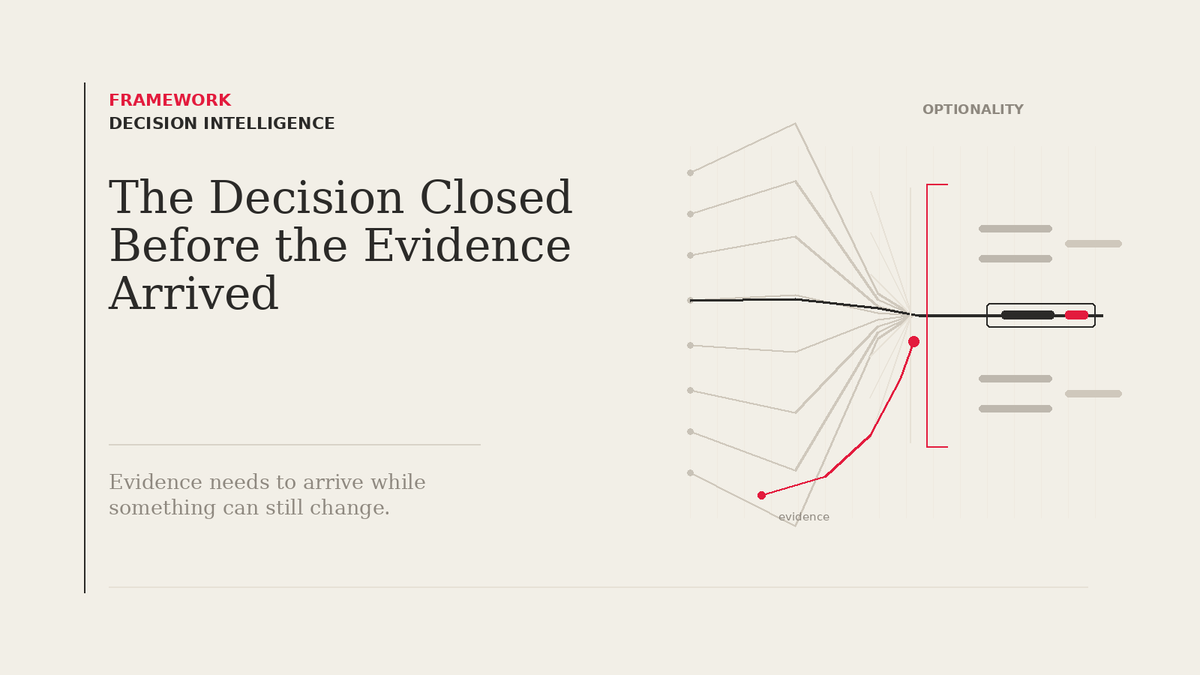
Good evidence can still arrive too late to influence the decision it was meant to support.
Working proposition
Evidence can influence a decision only while the organization retains enough optionality to act differently.
The challenge is that organizations often lose that optionality gradually, before anyone explicitly recognizes that the decision has closed.
I have been in meetings where a good piece of analysis gets exactly the response you would hope for.
People understand it.
The methodology is trusted.
The conclusion is clear.
There is even agreement about what the evidence seems to suggest.
And then someone says:
“That’s useful. We already committed the budget.”
Nothing went wrong with the analysis.
It was not ignored.
Nobody disputed the numbers.
The organization simply reached the answer after it had lost most of its ability to act on it.
That raises a question I do not think measurement teams ask often enough:
When did the decision actually close?
Decisions rarely close in one moment
We tend to imagine decisions as events.
There is a meeting.
People discuss the options.
Someone approves something.
The decision is made.
Sometimes it really works like that.
But many commercial decisions begin closing long before the final approval.
Finance reserves the budget.
Commercial agrees the calendar.
Procurement starts a process.
Inventory is allocated.
A partner holds capacity.
A team commits resources.
Someone presents the plan internally as if it is already happening.
None of those actions may formally constitute the decision.
But each one makes changing direction slightly harder.
The alternatives are still there.
They are simply becoming more expensive to choose.
Eventually, the organization reaches a point where the decision may technically remain open, but changing it would mean reopening budgets, renegotiating commitments or undoing work that other teams have already started.
Nobody has necessarily announced that the decision is closed.
Operationally, much of it already is.
I think of this as Silent Decision Closure:
the gradual loss of organizational optionality around a decision without a clear or shared moment of closure.
A decision can close across the organization before it closes anywhere in particular
This is the part I find most interesting.
Finance may still consider the decision open because nothing has been signed.
Commercial may already consider it effectively closed because the calendar has been agreed.
Procurement has started negotiations.
Operations has planned resources.
The measurement team sees a final approval meeting three weeks away and assumes there is still time.
Each team can be correct from where it sits.
And still, collectively, the organization may already have reduced most of its ability to choose differently.
A decision can close across an organization before it closes anywhere in particular.
That is why the official decision date can be misleading.
Imagine a Retail Media investment formally approved on September 30.
It would be easy to assume that evidence delivered before September 30 arrived in time.
But perhaps the Q4 budget was effectively fixed on September 10.
The retailer agreed the commercial calendar on September 12.
The media inventory was reserved on September 15.
By September 30, the organization is no longer choosing between the same set of alternatives it had three weeks earlier.
It is mostly confirming a direction that already has commitments built around it.
The meeting where a decision is approved is not always the moment when the organization still has the greatest freedom to choose.
Measurement has its own clock
Measurement systems also have timelines.
A campaign runs.
Enough data needs to accumulate.
The period closes.
Transactions are reconciled.
Control groups are validated.
Incrementality is calculated.
Someone reviews the analysis.
A report is prepared.
All of that can be completely reasonable.
The problem is that the business may be operating on another clock.
Budget planning happens earlier.
A renewal conversation starts before the campaign ends.
A seasonal calendar needs to be locked.
Inventory has to be secured.
A brand needs an answer by Friday.
So we can end up with two perfectly legitimate timelines:
measurement time
and
decision time.
They do not always meet.
A measurement system can be accurate, methodologically robust and commercially relevant — and still be badly synchronized with the decision it was supposed to support.
That is a different kind of failure.
The number is not wrong.
The representation may not even be wrong.
The evidence simply arrived after the organization had lost enough optionality that acting differently had become difficult.
The best evidence is not always the fastest evidence
There is an easy conclusion to draw from this:
measure everything faster.
I do not think that is the answer.
Some evidence takes time for good reasons.
Incrementality may require enough transactions to distinguish signal from noise.
A campaign effect may need a post-period.
Control groups need to be credible.
A directional answer tomorrow can be less useful than a robust answer next week.
So there is a real tension.
The fastest evidence is not always the best evidence.
But the reverse is also true.
The best evidence can arrive too late for the decision it was meant to influence.
The question is not simply how quickly measurement can be produced.
It is how much evidence a particular decision requires, and how much latency that decision can tolerate before the available alternatives begin disappearing.
There is no universal decision window.
But there is usually a point after which new evidence has less ability to change what happens.
Evidence can remain valuable after the decision closes
This distinction matters.
Evidence does not become worthless once a decision has been made.
A late incrementality study can still teach us something.
It can change the next campaign.
It can improve the next negotiation.
It can reveal that an assumption was wrong.
It can change the representation the organization carries into the future.
So I would not say that evidence loses its value when a decision closes.
It loses something more specific:
its ability to influence that particular decision.
That may sound like a small distinction.
Operationally, it is not.
Measurement is often justified because it will improve a decision.
If the evidence repeatedly arrives after the relevant choice has become difficult to change, then the organization may be producing valuable knowledge without producing much decision value.
Both matter.
But they are not the same thing.
Not every decision closes the same way
This phenomenon is stronger in some decisions than others.
A contract has a fairly obvious point of commitment.
An annual budget may have several.
A commercial calendar tends to harden over time.
But some systems constantly create new opportunities to act.
Always-on media can be reallocated.
Pricing can be adjusted.
Replenishment can respond to new information.
A decision made today does not necessarily eliminate tomorrow’s alternative.
In those systems, the window keeps reopening.
That does not make timing irrelevant.
It simply changes the cost of arriving late.
This is why I would be careful with the language of “real-time decision making.”
The important feature is not real time.
It is remaining optionality.
How much capacity does the organization still have to choose differently when the evidence arrives?
That is the clock that matters.
The question before the analysis
Measurement teams naturally ask:
When can we have the analysis ready?
Perhaps there is another question that should come first:
What decision is this analysis meant to influence, and when does the organization begin losing the ability to act differently?
That question changes the design of measurement.
A directional signal may be enough to keep an early option open.
A more robust analysis may support a later reallocation.
A post-period study may be valuable for the next renewal, even if it cannot change the current one.
The point is not to force every measurement into the fastest possible cycle.
It is to connect the latency of the evidence with the moments when the organization can still do something different.
Otherwise, we risk designing measurement around reporting deadlines rather than decision windows.
“That’s useful. We already committed the budget.”
Go back to the meeting.
The analysis is good.
The evidence is relevant.
Everyone understands what it means.
And the budget is already committed.
The evidence still has value.
Perhaps quite a lot.
But not for the decision it arrived too late to change.
The analysis was delivered on time according to the measurement process.
It was late according to the decision.
That difference is easy to miss because decisions rarely announce the exact moment when they stop being meaningfully reversible.
Budgets get committed.
Calendars harden.
Dependencies accumulate.
Alternatives disappear.
Then the evidence arrives.
Still useful.
Still informative.
But no longer able to influence the choice it was originally meant to support.
Evidence does not need to arrive only accurately.
It needs to arrive while something can still change.
This essay is part of the In-Store Retail Media Framework under Decision Intelligence. New readers can begin with Start Here or explore the Principles that guide the Journal.