One Total, Many Possible Patterns
A total can stay flat while the stores inside it move in different directions. Many different store patterns can add up to the same number, and the total alone gives no way of identifying which one produced it
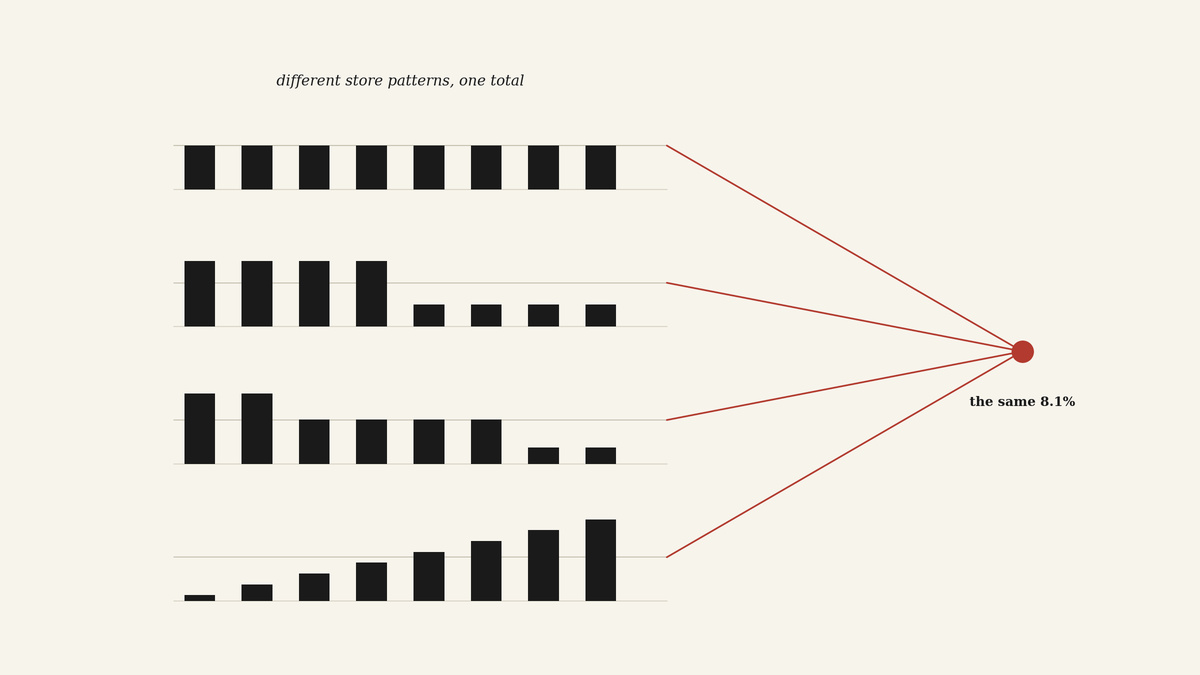
A total can stay flat while the stores inside it move. Many different store patterns can add up to the same number.
Working proposition
A representation can be accurate at the level it reports and still not preserve variation beneath that level that bears on the decision.
A retailer reviews a programme it ran across its stores. The report shows conversion rate before and after: 8.0%, then 8.1%.
The reading in the room is quick. Essentially flat.
Then someone opens the same report by store cluster. Same transactions, same definition of conversion, same period, same mix of visits.
High-traffic urban stores, about a quarter of visits: 10% to 13%.
Suburban stores, about half of visits: 8.0% to 8.2%.
Small-format stores, about a quarter of visits: 6% to 3%.
The 8.1% is accurate. It is exactly what those three figures add up to. Nothing in the measurement changed between the two views, and nothing was missing from either.
What changed is how many differences survived the step from stores to one number. Two movements that carried almost the same weight, in opposite directions, were absorbed into a total that barely moves.
This is different from reordering a table. When rows change order, every row is still there and can still be found. When rows are aggregated, the aggregate itself does not contain enough information to reconstruct them. Many different store patterns lead to the same 8.1%. The underlying store data may still exist elsewhere, but the 8.1% alone gives no way of identifying which pattern produced it.
It also changes what the decision can rest on. At the total level, the reported conversion rate is essentially unchanged, and the natural conversation is whether the programme is worth continuing as it is. At the cluster level, the same programme no longer looks commercially uniform: one segment improved materially, one barely moved, and one deteriorated. That makes a chain-wide decision harder to treat as though every store context were behaving the same way.
None of this is an argument for always opening the clusters. The cluster view is also a compression. It turns many stores into three groups, so differences between individual stores no longer remain visible at that level. A store-level view would retain more of this variation, but it would also be harder to use in a review. Aggregation trades detail for usability, and usability is a legitimate reason to make the trade. No level is sufficient in general. Which one is sufficient depends on the decision.
What the total does not carry is a record of what was compressed to produce it. A representation can be accurate and still stop preserving enough of Commercial Reality for the decision in front of it. Aggregation is one specific way that happens.
This essay is part of the In-Store Retail Media Framework under Commercial Representation. New readers can begin with Start Here or explore the Principles that guide the Journal.