The Same Evidence Does Not Produce the Same Judgment
The same representation can make a situation clearer without making judgment more consistent. Two people can work from the same evidence, objective and alternatives — and still make different calls.
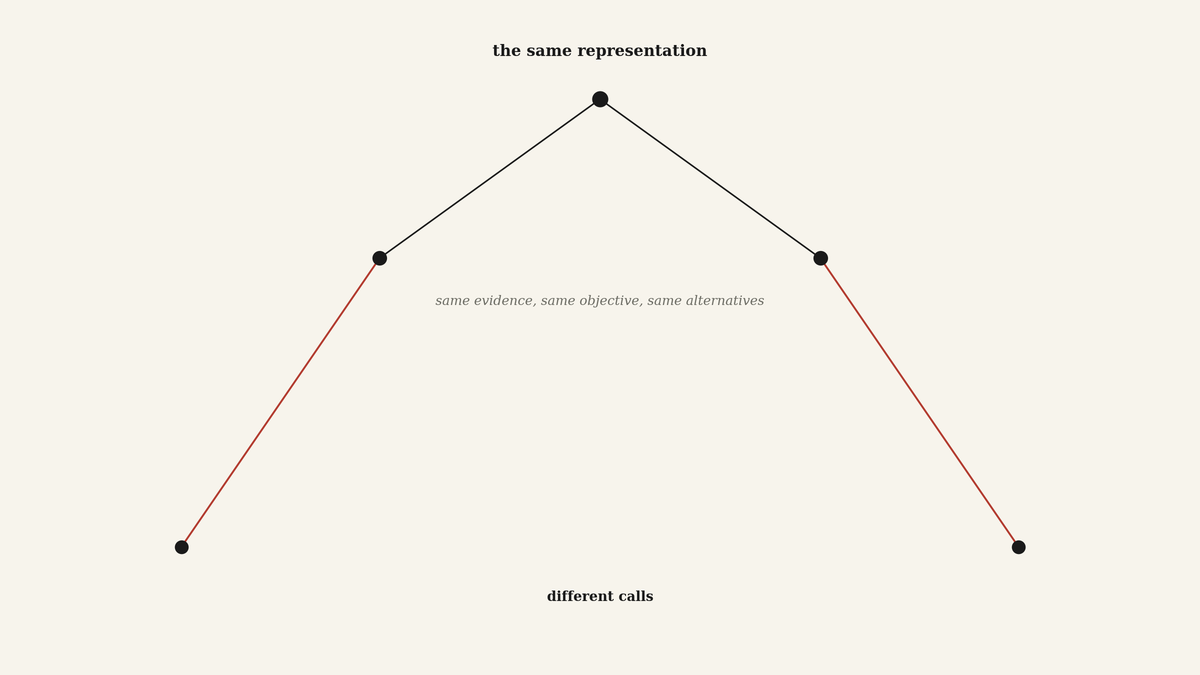
More clarity does not guarantee more agreement. Two people can see the same problem more clearly and still disagree about what to do.
Working proposition
Reducing uncertainty in the representation does not necessarily reduce variability in the judgment made from it.
By now this chapter has ruled out three ways a decision can go wrong before judgment even enters the room. The evidence can arrive too late to matter. It can reach someone without the authority to act on it. It can be evaluated inside a frame nobody thought to test. Assume all three are solved — the evidence is on time, the person reading it can act, and the frame is the right one. A fourth failure is still available. Framing determines the question. Interpretation determines what a person does with it — and two people can answer the same question, working from the same representation, and land somewhere different.
Not every difference here is a problem. If one person knows something the other doesn't — a supplier issue, a competitor move, a conversation with the store manager — a different call is exactly what should happen. That is evidence doing its job. The problem this essay is about starts when the relevant inputs are held constant and the judgment still moves.
A promotion is coming up for review. Two category managers get the same forecast, the same margin impact, the same historical response for this kind of promotion, the same stock position. Both are told to optimize for the same objective. Both have the same two options in front of them — run it as planned, or scale it back — and both have the authority to choose either one. One runs it as planned. The other scales it back.
Nothing here is a disguised framing problem. The objective was fixed externally, not left to each manager to define for themselves. The alternatives were the same two, named in advance. The unit of the decision — this promotion, evaluated as one call — never shifted between them. If the two managers had quietly been optimizing for different things, or comparing different sets of options, that would be the previous essay's failure showing up again with a new coat of paint. That is not what happened here. What happened is that the same objective, the same alternatives, and the same evidence produced two different answers.
It would be a mistake to read this as one manager being right and the other wrong. Nothing in the setup tells us which call was better — that is a separate question, and usually an unanswerable one after the fact. What the setup does tell us is that the two decisions cannot both be a direct, mechanical readout of the shared representation, because the shared representation itself does not explain why the judgments diverged. Somewhere between the same inputs and two different outputs, something varied that the representation itself does not contain. Call it judgment, call it interpretation — it is the layer where a person turns a shared picture of the business into a specific call, and it does not hold still just because the picture does.
The temptation is to treat this as an argument for removing that layer — give the decision to a rule, a score, a model, and the inconsistency goes away. That temptation is worth naming and setting aside. Nothing here establishes that either manager's call was worse, so nothing here establishes what a rule should have said instead. The finding is narrower and, if anything, more durable: a better representation can make the situation clearer without making the judgment made from it more consistent. Clarity and consistency are not the same achievement, and improving one does not automatically produce the other.
This chapter opened with a simple claim: better representation expands the possibility of better decisions. It does not determine them. The first three reasons why lived outside the representation itself — timing that closed before evidence arrived, authority that sat somewhere else, a frame nobody re-tested. This one lives inside it. The representation can be timely, in the right hands, and built around the right question, and the decision can still depend on who is reading it.
This essay is part of the In-Store Retail Media Framework under Decision Intelligence. New readers can begin with Start Here or explore the Principles that guide the Journal.