The Decision Was Made. Nothing Changed.
A decision can be sound, authorized and complete, while the action that eventually reaches Commercial Reality differs materially from what was decided. The intelligence loop does not close when a decision is made — it closes when that decision reaches reality.
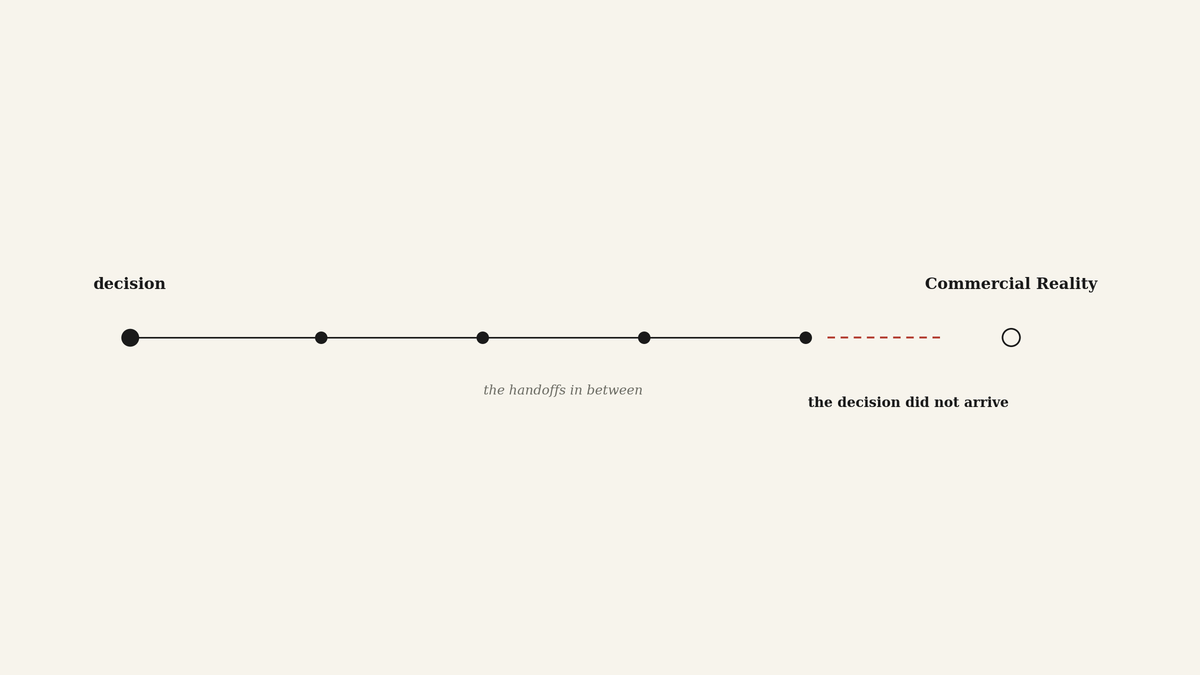
A decision does not change Commercial Reality by being made. It changes Commercial Reality by being carried into it — and that is a separate event, with its own way of failing.
Working proposition
A decision and its execution are separate organizational events. Improving the first does not guarantee the second will occur as intended.
Assume everything this chapter has covered so far went right. The evidence arrived while the decision was still open. It reached the person with the authority to act on it. The question behind it was adequately framed. Two reasonable people, looking at the same representation, reached the same judgment. The organization reached a well-supported decision.
Three weeks later, nothing in the store has changed.
A retail media team notices that a specific creative underperforms during certain dayparts, across a defined set of stores. The evidence is solid. It arrived in time. It reached the trade marketing lead with the authority to act on it, and the decision is straightforward: change the screen schedule in those stores, for those dayparts. The decision gets made.
The decision, on its own, changes nothing. For it to reach Commercial Reality — for a shopper standing in front of that screen next Tuesday to actually see something different — a series of other things has to happen first. In this retailer's operating model, that decision now has to become a specific instruction, accepted by the CMS as a schedule change that fits inside the current commercial calendar, received and applied by store operations, approved by the retailer, and finally live on the correct schedule at the correct stores — before the underperforming window has passed and the opportunity is gone.
None of this needs to be a technology problem. The CMS can accept the change instantly. The dashboard can confirm, correctly, that the new schedule has been saved. The failure this essay is about has nothing to do with any system being slow, and everything to do with what has to happen between a system accepting a change and that change actually reaching a shopper.
A decision and its execution are separate organizational events, made by different people, on different timelines, subject to different constraints. Improving the first does not guarantee the second will occur as intended. The trade marketing lead who decided to change the schedule does not control the commercial calendar, does not operate the CMS, and is not the one confirming that the correct stores went live. A decision can be sound, authorized and complete, while the action that eventually reaches Commercial Reality differs materially from what was decided. Getting the decision right was one problem. Getting it carried into every one of those systems, in the right order, before the window closes, is a different problem — and improving the quality of the decision does not guarantee the fidelity of its execution.
It would be easy to end here by saying execution is hard. That is true, and it explains nothing specific. Automation can remove some of those handoffs, and in some operating models that matters enormously. But that does not collapse decision and execution into the same event. Whatever remains between the decision and the operating environment still has to carry the decision faithfully into reality — and that translation is a distinct kind of work, with its own way of failing.
This is not the authority problem from earlier in the chapter — the trade marketing lead did have the right to make this call, and made it. Authority determines whether someone can decide; what happens next is whether the decision reaches people and systems who were never asked to decide, only to carry it out.
Nor is it the timing problem. That mechanism was a window closing before a decision could be made. This is what happens after the decision is made, when it still has to survive contact with a commercial calendar, a CMS, an approval chain and an operations team — any of which can absorb it, delay it, or quietly fail to carry it through.
It is easy for a measurement architecture to stop at the decision and treat what follows as somebody else's problem — to track the sale, the exposure, the attribution, the decision made in response to all three, and stop there, as though a decision were already the business outcome. But a framework that stops there has not yet closed the commercial loop. Everything before a decision is about building a representation good enough to act on. Everything after it is about whether the resulting decision is successfully carried back into the store. A retailer or a brand can be excellent at every stage leading up to the decision, and still not know whether last month's decisions ever reached a shelf, a screen or a schedule.
A decision is not the end of the intelligence loop. It is the beginning of the return to reality — and that return has to be built, tracked and protected as deliberately as the evidence that led to the decision in the first place.
This essay is part of the In-Store Retail Media Framework under Decision Intelligence. New readers can begin with Start Here or explore the Principles that guide the Journal.