Welcome
The Journal explores how physical commerce becomes observable, measurable and actionable — and how organizations turn Commercial Reality into better decisions.
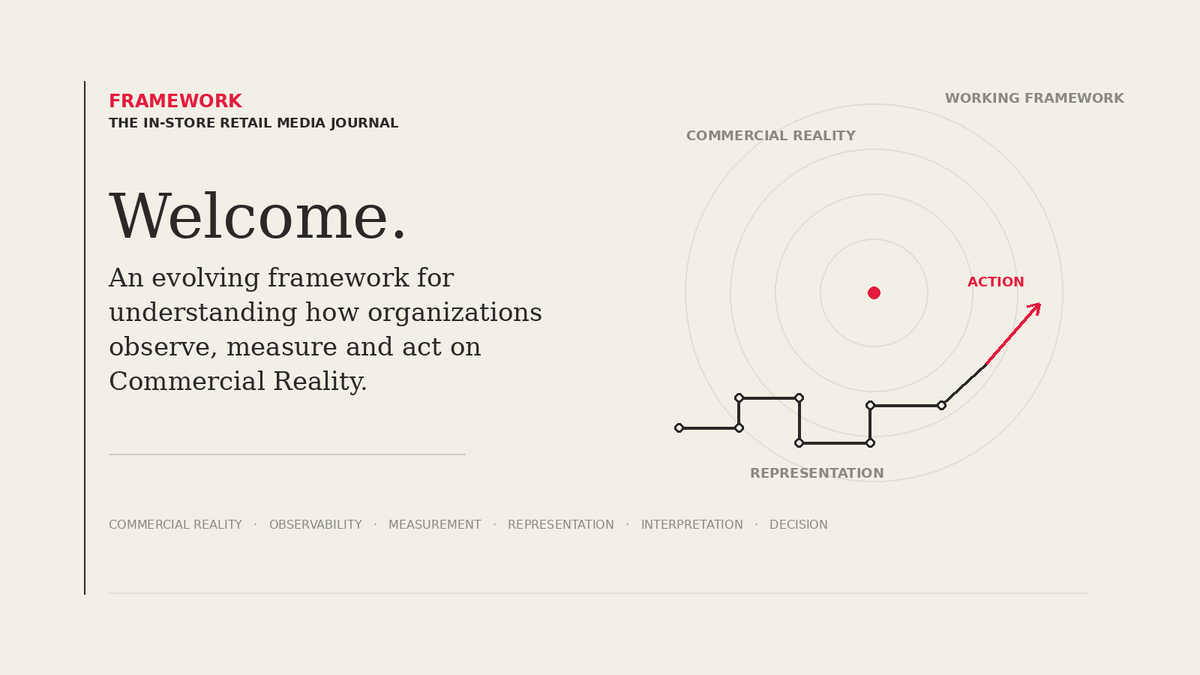
This Journal is an attempt to understand how physical commerce becomes observable, measurable and actionable. One essay at a time.
Welcome to the In-Store Retail Media Journal.
This project started with a fairly simple question:
What actually makes In-Store Retail Media different?
At first, I thought the answer was mainly about measurement.
A screen inside a store can deliver media.
But once you can connect exposure with shopper behavior, transactions and incremental outcomes, the conversation changes.
You stop asking only whether the media was delivered.
You can start asking what happened commercially because of it.
That question led to another.
And then another.
How much of what happens inside a store can we really observe?
How do we decide what is worth measuring?
What happens when a metric becomes important simply because it is visible?
How do dashboards, KPIs and models shape the way a business understands itself?
And eventually, I found myself asking a broader question:
How do organizations turn a complex Commercial Reality into evidence good enough to support better decisions?
That is now the question at the center of this Journal.
In-Store Retail Media is where the thinking began
The Journal is still deeply rooted in In-Store Retail Media.
That is not accidental.
Physical retail is a particularly interesting place to think about these problems because so much happens that traditional commercial systems only partially see.
A shopper can notice a product and never buy it.
They can pick something up, hesitate and put it back.
An ad can be delivered without being noticed.
A sale can happen without the media having caused it.
Price, availability, promotion, context and shopper behavior can all influence the same outcome.
The store is full of commercial activity.
But most systems only capture part of it.
That gap between what actually happens and what the organization can observe is one of the reasons I became interested in building this framework in the first place.
In-Store Retail Media gave me the starting point.
It is no longer the limit of the investigation.
A framework that is still being built
I do not want this Journal to become a collection of disconnected opinions.
Each essay should add something to the same body of thought.
Sometimes that means developing a concept.
Sometimes it means challenging one.
Sometimes it means realizing that a distinction we were using was too simple.
The framework currently revolves around ideas such as:
- Commercial Reality
- Observability
- Commercial Measurement
- Commercial Representation
- Interpretation
- Decision Intelligence
- Commercial Outcomes
- Action
Together, they describe a problem that I keep seeing in different forms.
Organizations cannot deal with Commercial Reality in all its complexity.
They make parts of it observable.
They measure those parts.
They build representations from what they can see.
They interpret those representations.
Then they make decisions.
And those decisions change the same reality they were trying to understand.
If you are new here, Start Here is the best place to see how those pieces connect.
The Principles are working propositions
Alongside the essays, there is a page of Principles.
I do not want that page to become a collection of clever statements.
If an idea belongs there, it should be because it has been developed, challenged and still seems useful.
Some of the current propositions are:
Organizations act on representations of Commercial Reality, not Commercial Reality itself.
Measurement exists to improve decisions.
Media delivery is not commercial impact.
Context can be more valuable than identity.
The Intelligence Moves. The Data Stays.
I expect some of these ideas to become stronger over time.
Others may need to change.
That is part of the point.
Measurement is important, but it is not the destination
Measurement has become one of the main themes of the Journal.
Not because more data is automatically better.
And not because every new KPI deserves attention.
What interests me is what measurement does to the way an organization sees the business.
What becomes visible tends to get discussed.
What gets discussed tends to receive attention.
And over time, what receives attention can begin to influence what the organization believes matters.
That is why some of the essays explore questions such as:
Do organizations measure what matters, or do they learn to care about what they can measure?
And:
What can new data help us understand that our previous measurement systems could not represent?
Observed Sales, Attributed Sales and Incremental Sales are still important ideas in the Journal.
But they now sit inside a wider question:
Are we making the right parts of Commercial Reality observable for the decisions we need to make?
Most of the ideas start with something practical
Some essays begin with a disagreement I have with an assumption in the industry.
Others start with something much smaller.
A question from a retailer during a product demo.
A KPI that everyone accepts without discussing why.
A dashboard that seems to tell a complete story but clearly leaves something out.
A conversation that changes once a new type of data becomes available.
I find those moments useful because they often reveal a bigger conceptual problem underneath.
The objective is not to be provocative for the sake of it.
And I am not trying to make the Journal sound more certain than the thinking really is.
The idea is to keep following the problem until the distinction becomes clearer.
A perspective shaped by physical retail and Latin America
Much of my experience has been built across Brazil, Mexico and the wider Latin American market.
That inevitably shapes the way I see these questions.
Physical retail still plays a central role across the region, and many of the most interesting measurement problems are happening inside environments where digital and physical commerce increasingly overlap.
But I do not think the questions in this Journal belong only to Latin America.
Any organization trying to understand a commercial environment through incomplete data, dashboards, models and assumptions faces some version of the same problem.
The store simply gives us a very tangible place to examine it.
This Journal is still evolving.
I expect some ideas to survive.
Some to be refined.
And probably a few to be discarded.
That is fine.
I would rather let the framework become stronger through disagreement than protect an idea simply because I wrote it first.
So if one essay brings you here, I hope you keep reading.
The next one may challenge the previous one.
And, over time, the connections between them should become clearer.
Welcome.