Physical Retail Media Is Not DOOH Inside the Store
Putting a screen inside a store does not automatically create In-Store Retail Media. The medium becomes more valuable when exposure can connect with commercial outcomes and decisions.
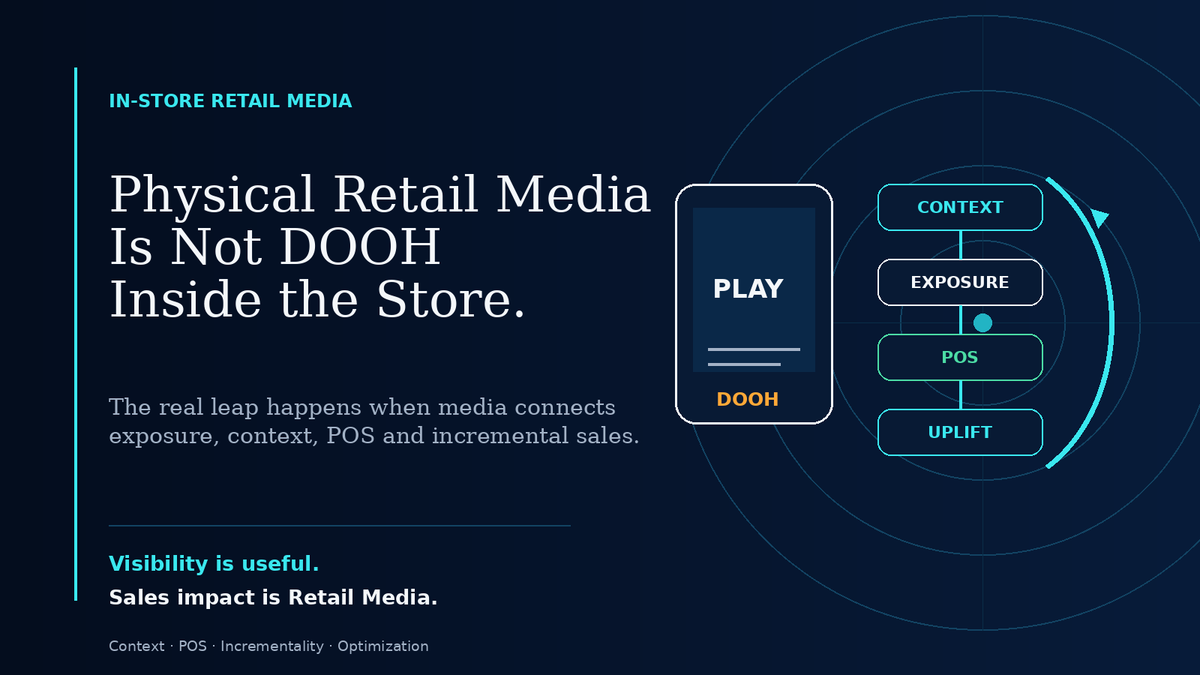
The real leap happens when in-store media connects exposure, context, POS and incremental sales.
FRAMEWORK — INDUSTRY CRITIQUE
Putting screens inside a store does not automatically mean you are doing Retail Media. It may simply mean you are doing DOOH in a retail environment.
Over the last few months, in conversations with retailers, agencies and brands, I have noticed that the same question keeps coming up: where is the line between in-store DOOH and true Retail Media?
That line matters.
As Retail Media matures, the market will need to distinguish more clearly between exposure-based inventory and a true media platform connected to data, transactions and commercial outcomes.
DOOH inside the store has value. It delivers presence, visibility, frequency and the ability to communicate in high-traffic physical environments. Well-positioned screens can reinforce brands, support promotions, increase recall and influence decisions close to the point of purchase.
But that alone does not capture the full potential of physical Retail Media.
The physical store has something very few channels can offer: extreme proximity to the purchase decision. The shopper sees the message, is in front of the category, the product is available, and conversion can happen in that same moment. That proximity makes the physical store one of the most powerful environments to influence purchase behavior.
So the question cannot only be: How many times was the campaign displayed?
The question needs to evolve into: What impact did that exposure generate in sales?
The Difference Between Being Seen and Selling
A significant part of in-store media is still bought and evaluated through delivery metrics: number of activated screens, plays, estimated impressions, location, campaign period and coverage. These metrics matter. They help prove that the campaign was delivered properly. But they do not prove business results.
A brand may know that its campaign ran across 100 stores, for 14 days, on screens close to a strategic category. That is useful. But it still does not answer the questions that really matter to the business: did the campaign generate incremental sales? Which stores performed best? Which areas of the store had the strongest impact? Which time slots concentrated higher conversion? Did the growth come from the campaign, or would it have happened anyway?
This is where the difference begins between DOOH inside the store and performance-driven physical Retail Media.
The first delivers visibility in a retail environment. The second connects that visibility to real purchase data.
Retail Media Starts When Media Becomes Part of the Retailer’s Commercial Ecosystem
Physical Retail Media should not be treated only as an extension of media inventory. It should become part of the retailer’s commercial ecosystem.
That means connecting activation with store data, purchase context, product availability, aggregated behavior, POS and sales outcomes. When that happens, the screen stops being only a communication point. It becomes a decision point within a broader system.
A system capable of answering not only where the campaign appeared, but where it generated growth. Not only which inventory was used, but which inventory had the highest commercial value. Not only who was exposed, but which contexts created a higher probability of conversion.
This shift is essential because the value of Retail Media is not only in the audience. It is in the ability to connect audience, exposure and transaction.
In digital, this logic is already well understood. Retail Media grew because it brought shopper data, media activation and conversion closer together. In physical retail, the same discipline now needs to be built inside the store.
POS Changes the Nature of Physical Media
POS is the element that changes everything.
Without transactional data, an in-store screen remains primarily a visibility asset. With POS, it can become part of a performance system.
Once in-store exposure is connected to sales by SKU, category, store and period, the retailer begins to understand not only whether the campaign was delivered, but whether it contributed to commercial growth.
This allows the market to move from metrics such as activated screens, number of plays, estimated impressions, coverage and location to metrics such as incremental sales, uplift by store, screen, area and time slot, impact by SKU and category, incremental ROAS, exposed versus control groups, and optimization opportunities during the campaign.
This evolution changes the conversation with brands and agencies. Inventory stops being sold only as space. It starts being sold as the ability to generate measurable impact.
The Layers Required for Performance-Driven Physical Retail Media
For in-store media to move beyond DOOH and become performance-driven physical Retail Media, several layers need to be connected.
Technology matters because it turns a screen into a measurable commercial decision point.
The first layer is inventory: screens, store areas, time slots, formats, availability and proximity to strategic categories. Without a qualified view of inventory, all screens tend to look the same, even when their commercial impact can be very different.
The second layer is context: traffic flow, dwell time, store area, category, shopping mission, time of day and aggregated audience signals. In the physical environment, context is a critical variable. The same campaign can generate very different results depending on where and when it appears.
The third layer is delivery: activation rules, contextual targeting, pacing, frequency and the ability to adjust delivery by store, screen, area or time slot. This allows the campaign to move beyond a fixed loop and respond to the environment.
The fourth layer is POS: sales by SKU, category, store and period. This connection is what makes it possible to turn exposure into commercial impact.
The fifth layer is measurement: control groups, incremental uplift, ROAS, comparison between exposed and non-exposed groups, and analysis of expected sales versus observed sales.
The sixth layer is optimization: learning during the campaign, identifying higher-conversion contexts and moving delivery toward opportunities with a greater probability of generating results.
Without these layers connected, in-store media remains primarily exposure. With them, it starts operating as a performance platform.
Not Every Sale During a Campaign Is Incremental
One of the biggest risks in physical Retail Media is confusing correlation with impact. If sales of a product increase during a campaign, that does not automatically mean the campaign caused that increase. Some of those sales could have happened even without media.
There may be effects from price, promotion, seasonality, higher store traffic, product availability, external campaigns, regional behavior or the natural trend of the category. That is why the credibility of physical Retail Media will depend on the ability to measure incrementality with rigor.
The market will need to distinguish between three concepts: observed sales, the total sales during the campaign; attributed sales, sales linked to media exposure within a defined methodology; and incremental sales, additional sales that would likely not have happened without the campaign.
This distinction is essential. The goal is not only to show that sales happened. The goal is to estimate how much of those sales were actually generated by the campaign.
To do this, physical Retail Media needs methodologies that compare exposed stores, periods or contexts against relevant control groups. It needs to consider historical sales, seasonality, stock, price, promotions and category behavior. Without this discipline, the channel risks becoming just another exposure metric. With it, it can become a credible performance channel.
Context Is the New Value Asset
In the physical store, context matters a lot. The same campaign can generate completely different results depending on the store, time of day, store area, category, shopper flow and shopping mission.
A message displayed near the category can have a different impact than the same message displayed at the entrance. An ad shown during a high-conversion time slot may perform better than during a high-traffic moment with low purchase intent. A campaign in an urban store may respond differently than in a suburban store or in a store with a strong presence of small businesses.
This is especially relevant in formats such as cash & carry, pharmacies, convenience stores and high-frequency supermarkets, where different shopping missions coexist in the same environment.
So the question should not only be: Which screen has the largest audience?
The better question is: Which context has the highest probability of generating incremental sales?
For me, this is one of the most important shifts in the category. The future of physical Retail Media will not be defined only by the size of the network. It will be defined by the ability to qualify inventory by context and outcome.
The Role of Privacy
The evolution of physical Retail Media also needs to be built responsibly. If the channel depends on sensors, contextual data and audience signals, privacy must be part of the model by design.
The goal should not be to identify people. The goal should be to understand aggregated contexts that help improve media relevance and measure commercial impact.
That means working with anonymized, probabilistic and aggregated signals, avoiding facial recognition for identification, individual profiling or cross-store re-identification.
The physical store can be a highly intelligent environment without becoming an invasive environment. That distinction will be decisive for the trust of retailers, brands, agencies and consumers.
Why This Matters for Retailers
For retailers, the difference between DOOH in-store and performance-driven physical Retail Media is strategic.
If in-store media is sold only as DOOH, its value tends to be defined by reach, location and presence. These factors remain important, but they have a commercial ceiling.
If it is sold as performance Retail Media, its value can be defined by commercial impact: incremental sales, ROAS, category, store, time slot, area and context.
This opens new possibilities: creating premium inventory based on real performance, justifying higher prices for specific media assets, offering stronger proof to brands, optimizing campaigns while they are still live, turning POS into a commercial intelligence engine, and competing for media, shopper marketing and performance budgets.
The retailer stops selling only physical space. It starts selling the ability to generate measurable growth.
Why This Matters for Brands and Agencies
For brands and agencies, the shift is equally significant. Buying in-store media stops being only a decision about where to appear. It becomes a decision about where to generate growth.
This changes planning questions. Instead of asking “How many screens can we buy?”, the brand starts asking “Which stores, areas, time slots and contexts have the highest conversion potential?”
Instead of asking “What was the campaign coverage?”, the question becomes “What was the incremental uplift?”
Instead of asking “Was the campaign delivered?”, the question becomes “What did we learn to optimize the next activation?”
This is the kind of shift that allows in-store media to move beyond being seen as a complement to trade marketing and start competing for performance budgets.
The Future Will Not Be Only About Being Seen
DOOH inside the store will continue to be relevant. It plays an important role in building presence, recall and activation at the point of sale.
But physical Retail Media needs to go further. The next phase will be defined by those who can connect physical inventory, purchase context, POS, uplift and optimization.
Because the physical store is not only a place where media can be displayed. It is an environment where purchase decisions happen in real time.
For me, the line is clear: Retail Media starts when visibility can be connected to sales impact.
The future of in-store media will not only be about being seen. It will be about proving that it sells.
This essay is part of the In-Store Retail Media Framework, under Industry Critique. Start with the Start Here overview, or browse the Principles.