A Zero Does Not Say Where the System Looked
A zero can be perfectly accurate and still leave out the boundary needed to interpret it. Before turning an observed zero into a claim about Commercial Reality, ask what the system was actually in a position to observe.
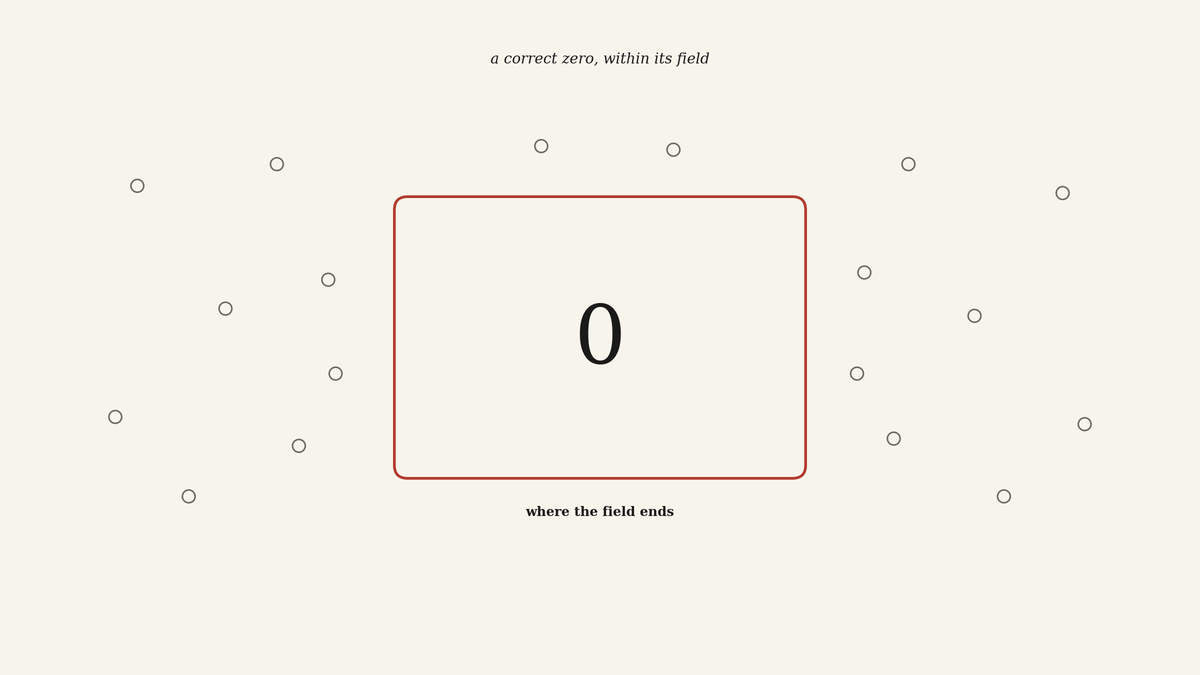
The system can say zero without telling you how far it was able to look.
A retailer is reviewing one screen to decide whether a creative should keep its placement. The report for the 14:00–15:00 window reads:
Observed dwell events: 0.
The system is working as intended. The sensor is healthy, the pipeline is working, the timestamp is correct, the metric is the same one used last week, and no records are missing. The zero is accurate. It is exactly what the system was built to say.
The earlier observability essay was about events that never became records at all. This is different. Here, the system did produce a record. The record says zero. The problem is that the zero does not tell us how much of Commercial Reality was inside the system's field of observation.
Working proposition
The meaning of an observed zero depends on the coverage that produced it, and that coverage is not contained in the zero itself.
Every observation system has a boundary, which is its coverage. It watches a particular area and a particular window. Inside that boundary, a zero means something. Outside it, the system has no way of reporting, and the zero can look exactly the same.
In this case, the sensor observes a defined zone in front of the screen. A shopper who looks at the screen from the side, from the next aisle, or from the far end of the display may be partly outside that zone. We do not know. That is the point: nothing in the report says.
A review can then move from "Observed dwell events: 0" to "nobody engaged with this screen." But the second statement is not contained in the first. It adds a premise: that the behavior that matters would have fallen inside what the system could see. The premise may be true. It may be mostly true. The zero does not contain it.
This matters because someone may reduce the placement, or pull the creative, on the strength of that conclusion. This essay is not arguing against that decision. The claim is narrower. The decision would rest on a premise about the system's field of observation, and the report does not say where that field ends.
The boundary can be spatial, as here. It can be temporal, if the system observes only defined windows or intervals. In each case the record can be perfectly valid within the area it covers while remaining silent about what fell outside it. A zero is an observation. It is not a map of the observation boundary.
None of this is an argument for observing more. A system can reasonably be built to look at less than everything, and sometimes it should be. Limited observability is not a defect to be fixed by default. It is a property that the meaning of every number inherits.
Before turning a zero into a claim about Commercial Reality, ask what part of that reality the system was actually in a position to observe.
This essay is part of the In-Store Retail Media Framework under Observability. New readers can begin with Start Here or explore the Principles that guide the Journal.