What the Transaction Never Sees
A transaction can tell us what was sold. It cannot always tell us what happened before the sale — or what happened when no sale occurred at all.
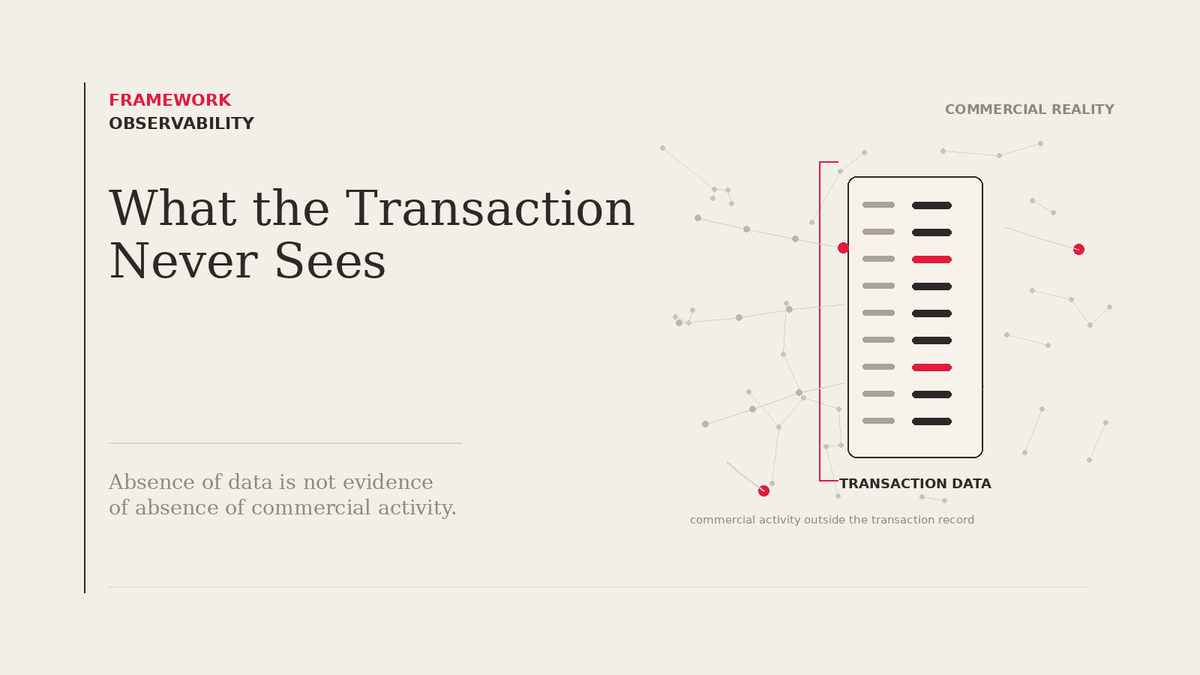
Absence of data is not evidence of absence of commercial activity.
Working proposition
Observability determines which parts of Commercial Reality can become available for measurement, representation and decision.
The goal is not to make everything observable. It is to make the relevant parts of reality visible enough to improve a decision.
I have watched shoppers stand in front of a shelf for a surprisingly long time and still leave without buying anything.
Sometimes they pick something up.
Sometimes they compare two products.
Sometimes they look at the price and put the product back.
Sometimes the thing they came for simply is not there.
Then they walk away.
In the transaction data, that entire episode can disappear.
No sale.
No basket entry.
No revenue.
Nothing for the POS to record.
It is easy to describe that as nothing happening.
But that is not quite right.
The system did not see nothing. It recorded nothing.
There is a difference.
And that difference matters.
The transaction sees the outcome
Transactional data is one of the strongest forms of commercial evidence we have.
It tells us what sold, where, when and at what price. Connected to loyalty or basket data, it can tell us much more.
But a transaction mostly records an outcome.
It does not necessarily tell us how that outcome came about.
Two shoppers can buy exactly the same product and leave exactly the same record in the POS.
One may have entered already planning to buy it.
Another may have noticed it because of a display.
Another may have switched from a competitor at the shelf.
Another may have bought it because the product they really wanted was unavailable.
The transaction is the same.
The commercial path is not.
And when there is no transaction, the gap becomes larger.
Imagine 100 shoppers arriving with the intention to buy a product.
Seventy find it and buy it.
Thirty discover that it is unavailable and leave.
The POS records 70 units sold.
That number may be perfectly accurate.
But Commercial Reality contained something else as well:
100 units of demand.
30 failed opportunities to convert it.
Those thirty do not appear as sales.
In many systems, they barely appear at all.
Yet if the decision concerns availability, assortment or replenishment, they may matter enormously.
The absence of a transaction did not remove the commercial activity.
It removed our evidence of part of it.
Sometimes the blind spot sits between signals we already have
Not every observability problem comes from missing data.
Retailers often already know a great deal.
They know store traffic.
They know what media was delivered.
They know stock levels.
They know transactions.
They may know loyalty behavior.
Each signal can exist perfectly well on its own.
And yet the commercial relationship between them may remain difficult to see.
We know an ad was delivered.
We know a product was purchased.
But did one influence the other?
We know traffic increased.
We know sales did not.
But was the problem price, availability, assortment or something else?
We know a product went out of stock.
We know category sales changed.
But how much demand was lost, and how much moved somewhere else?
Sometimes the missing information is not another signal.
It is the relationship between signals we already have.
This becomes especially important in In-Store Retail Media.
Exposure can be visible.
Transactions can be visible.
Store traffic can be visible.
But the sequence:
exposure → behavior → transaction
may still be largely invisible.
Having the pieces is not the same as being able to see the commercial process connecting them.
We can become very good at measuring what we can already see
This is where Observability and Measurement begin to separate.
An organization can improve measurement enormously without changing the boundary of what it can see.
Reporting gets faster.
Definitions become more consistent.
Historical series get longer.
Dashboards improve.
Numbers become more precise.
All of that can be valuable.
But it may simply mean that we are becoming increasingly sophisticated at describing the part of Commercial Reality that was already visible.
A retailer can measure transactions with extraordinary precision while knowing very little about lost demand.
A media platform can measure delivery almost perfectly while knowing very little about attention.
A promotion report can show units sold accurately while saying little about substitution or purchases brought forward from the following week.
The measurements are not wrong.
The limitation sits one step earlier.
A relevant part of reality never entered the observable world from which those measurements were built.
That can create a strange kind of confidence.
More data.
Better reporting.
More reliable metrics.
And yet part of the commercial problem remains outside the system altogether.
Seeing more is not the objective
The obvious response would be to observe more.
More signals.
More connections.
More behavioral data.
Sometimes that is exactly what is needed.
But not always.
If we could record every glance, movement and hesitation inside a store, we would certainly have more data.
I am less certain that we would have better decisions.
A shopper spending five seconds longer at a shelf could mean interest.
Or confusion.
Or difficulty finding something.
Or nothing worth acting on.
The fact that something becomes visible does not make it commercially important.
Observability creates the possibility of understanding something. It does not create its relevance.
That still depends on the decision.
If I am trying to improve replenishment, failed purchase attempts may matter a great deal.
If I am verifying whether media played at the agreed time, they probably do not.
If I am trying to understand whether an In-Store Retail Media campaign generated incremental demand, then exposure, shopper behavior and transactions may need to become connected.
The objective is not to make the store completely observable.
The better question is:
What do we need to be able to see in order to make this decision better?
The boundary moves
What makes this interesting is that the answer changes over time.
Commercial activity that once disappeared almost completely can sometimes now leave a usable trace.
Behaviors that used to exist only in the physical world can become observable.
Transactions that once lived separately from media exposure can be connected.
Patterns of lost demand that once existed mainly as intuition can sometimes be inferred.
Technology matters here.
But its most interesting effect is not simply that it creates more data.
It moves the boundary of what an organization can ask about Commercial Reality.
Once failed purchase attempts become observable, we can ask better questions about lost demand.
Once media exposure can be connected with transactions, we can ask whether exposed shoppers behaved differently.
Once traffic, availability and sales can be considered together, we can start separating lack of demand from failure to convert demand.
The commercial activity was there already.
What changed was our ability to make enough of it available for reasoning.
And sometimes that creates something more valuable than another KPI.
It creates a question that was previously very difficult to answer.
Nothing happened
Go back to the shopper at the shelf.
They stop.
Look.
Compare.
Perhaps search for something that is not there.
Then they leave.
The transaction system records nothing.
It is not wrong.
It has done exactly what it was designed to do.
The mistake would be to treat that absence as a complete description of what happened.
Sometimes no transaction really does mean that nothing commercially important occurred.
Sometimes it does not.
The difficult part is knowing the difference.
That is why Observability has to come before Measurement.
Before asking whether a number is accurate, we should sometimes ask whether the relevant phenomenon had any chance of becoming a number at all.
A system can be perfectly accurate about what it records.
The harder question is whether what it records is enough.
Because sometimes the most important commercial event is not hidden somewhere inside the data.
It never became data in the first place.
This essay is part of the In-Store Retail Media Framework under Observability. New readers can begin with Start Here or explore the Principles that guide the Journal.