There Is No Single Gap Between Evidence and Action
A commercial outcome that fails to materialize does not identify where the path from evidence to action broke. Different breakdowns along that path can leave the organization with the same unresolved problem — and this chapter has isolated them one by one.
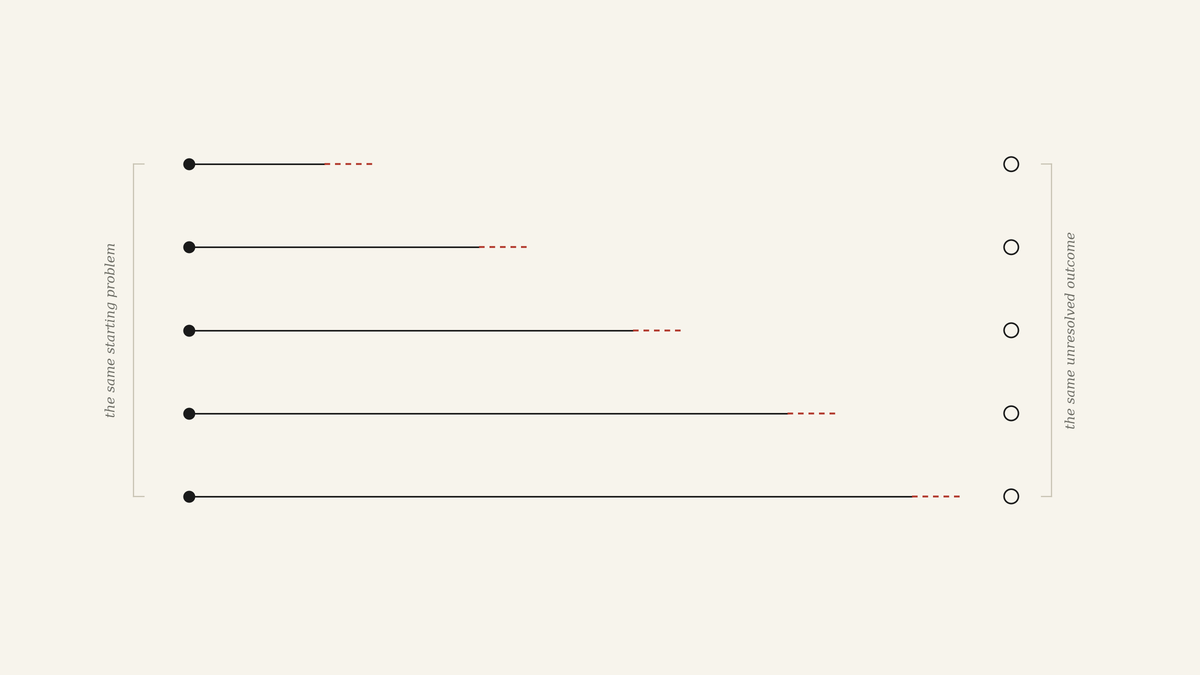
The visible outcome tells you that the loop did not close. It does not tell you where it broke.
Measurement Exists to Improve Decisions opened this chapter with a premise, not a mechanism: information only matters if it changes what an organization does next. The five essays that followed took that premise seriously by asking where, exactly, that change can still fail to happen.
Evidence can arrive after the window to act has already closed. It can reach the wrong desk — someone who sees the problem clearly but cannot change it. It can be measured accurately and still answer a question that was never quite the right one. Two people can look at the same representation and reach different judgments from it. And a decision, once made, can simply fail to survive the distance between being decided and being executed.
Five different places. Five different essays, each isolating one of them by holding the other four constant. From outside the organization, all five can leave the same visible trace: the business problem is still there.
Working proposition
A commercial outcome that fails to materialize does not identify where the path from evidence to action broke. Different breakdowns along that path can leave the organization with the same unresolved problem.
Take one commercial decision — a chain deciding to change how a screen is scheduled in response to underperforming conversion — and run it through each failure in turn. In one version, the evidence was solid, but by the time anyone acted on it, the promotional window it applied to had already closed. In another, it reached someone who agreed with it completely and had no authority to change the schedule. In another, the evidence was excellent, but the decision stayed organized around a question nobody had re-tested. In another, two people saw the same numbers and made different calls about what they meant. In another, the decision was approved, well-supported, and never actually reached the stores it was meant to change.
Five different stories. The same visible result: the problem the organization was trying to solve is still there.
The fact that the same symptom can have different causes is not the argument. The argument is that, between evidence and action, commercial decisions can break at several specific connections — and this chapter has already isolated them one by one.
That has a practical consequence most measurement conversations skip. An organization that treats "the expected outcome did not appear" as a single category of failure can easily fix the wrong thing: adding more evidence to a process where the evidence was never the problem, or refining a decision that was already sound but never reached the floor. The visible outcome and the location of the failure are not the same information. Treating them as though they were can lead the organization to respond to different failures in exactly the same way.
None of this argues that one system should own every transition between evidence and action, or that locating the break is mainly a matter of better tooling. The point is narrower: treating five distinct failures as one undifferentiated problem makes something solvable harder to see, not easier.
There is no single gap between evidence and action. There are different places where the connection can break.
This essay is part of the In-Store Retail Media Framework under Decision Intelligence. New readers can begin with Start Here or explore the Principles that guide the Journal.